Baby Shower RSVP Deadline and Follow-Up Messages
Set the guest cutoff days ahead of the vendor's headcount date.

A workable baby shower RSVP deadline leaves a buffer between the date guests must reply and the date vendors need final numbers.
Why the RSVP deadline is a two-date problem, not one
The planning mistake is treating the guest cutoff as the only deadline. After it comes a firm deadline, when the caterer, venue, or bakery needs the final headcount. Guests may forget to reply, but the vendor still needs to know how many are coming. Those are two different pressures on the calendar. Giving them the same date leaves the host chasing answers at the exact moment the food order needs confirming.
That collision is avoidable, but not through firmer invitation wording alone. The calendar needs room for the missing replies. Without that time, even a polite reminder comes too late to help with the count the vendor needs.
When to send invitations and where to put the RSVP deadline on the calendar
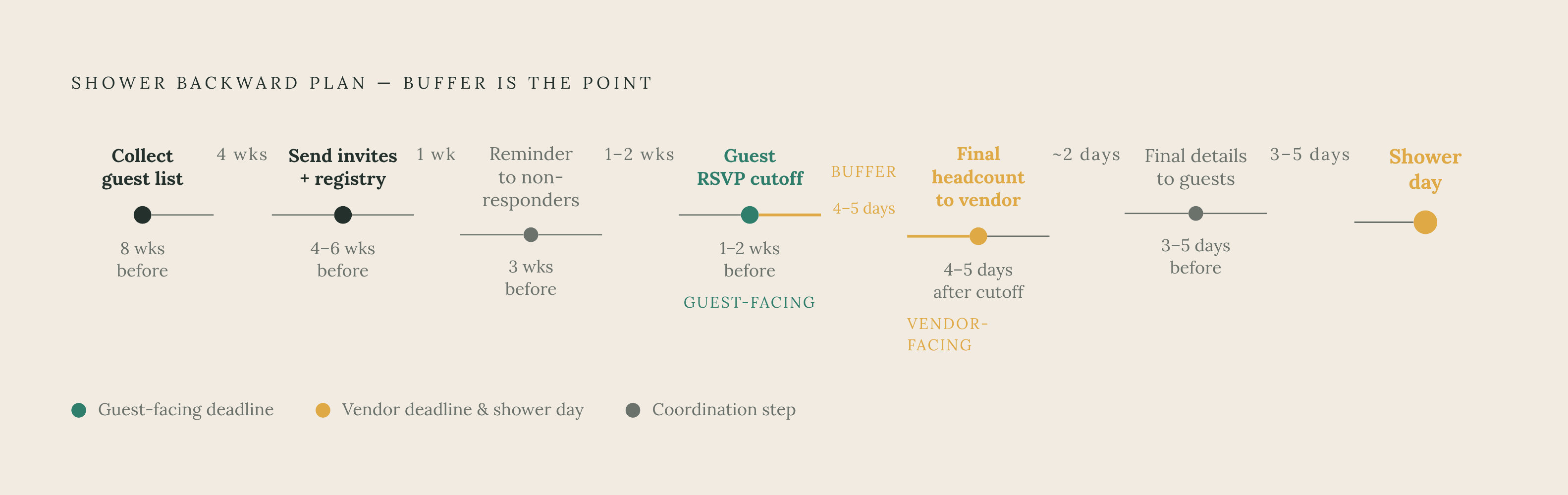
For a catered shower or one held at a venue, ask for the latest headcount change date first. That answer anchors the rest of the schedule. Place the guest deadline a few days before it, with enough space for the follow-up sequence you intend to use. If the final notice will go out four to five days after the guest cutoff, that interval must fit before the vendor needs the number. A buffer that expires before the final reminder is not much of a buffer.
Work backward from there to the invitation send date. If the invitation goes out earlier than eight weeks before the shower, guests may forget about it. If it goes out later than three weeks before, guests may already have other plans. Four to six weeks before gives the invitation its place between those extremes. The send date and reply date need to work together, rather than leaving guests with a deadline that feels like it arrived before the invitation.
Eight weeks before the shower, collect the guest list from the parent-to-be. Send the invitation four to six weeks before, with the RSVP deadline and registry link. Plan the first reminder for three weeks before the shower and the guest cutoff for one to two weeks before. Then plan to send a message with the final details to guests who have said yes three to five days before the event. These dates are a guide, and the cutoff depends on when the vendor needs the final number.
Paper invitations need about a week for printing and posting, so allow for that work before the intended send date. Digital invitations remove that lead time. They also bring replies into one trackable list rather than leaving the host to gather phone messages. Neither format changes the need for a buffer. It changes how much preparation comes before sending and how much sorting comes after.
How to word the RSVP deadline on the invitation so guests actually respect it
Once the dates are set, give the RSVP line a clear request and a reason. “Please RSVP by [date] so we can finalise the catering headcount” tells guests both what to do and why the date exists. The reason does useful work here. Without it, the cutoff can look like a preference. With it, guests can see that their reply affects an order.
Give guests one clear way to answer, whether that is a link, a number, or a named person to text. More options are not automatically more helpful. When replies come in through several channels, it is harder to check the list, especially as the deadline gets closer. A single route also makes reminders simpler because each one can point back to the same place.
Match the wording to the invitation without softening the date. A formal version can read, “Kindly reply by the first of September.” A modern, minimal version can read, “RSVP to Nina by July 25. [link]”. The surrounding invitation can supply the warmth or formality, while the RSVP line gets on with its job.
For a virtual or hybrid shower, the reply also needs to settle how the guest will attend. Use “Please RSVP with your preferred option — in person or online — by [deadline].” The guest does not have to infer whether a yes means a seat in the room or a place online. Clear wording prevents that ambiguity before it becomes another follow-up message.
What digital RSVP tracking changes about managing the deadline
A digital invitation page with an RSVP link makes the guest list readable before the chasing begins. The host can see who has replied, who said yes, who said no, and who has not answered. The host can see all of this without sending a message first. A missing response is visible as a missing response, rather than something that might be hiding in a text thread.
Give everyone on the guest list the same way to reply. If some answers are in a group chat, others come by paper card, and others come by text, the main list no longer shows all the replies. The deadline then becomes harder to manage cleanly. A host may be ready to send reminders but still need to search several places first. Digital tracking helps most when the list is not competing with three unofficial versions of itself.
A warm welcome message and a photo add character, while an optional field lets guests leave a message for the parent-to-be. Keep that extra contribution optional. Guests still need to give the host a clear answer.
After the deadline, the guest list can be downloaded for the caterer without retyping a notebook or counting texts. Before that handoff, the same list identifies exactly who needs a reminder. Guests who already replied do not receive a blanket nudge that suggests their answer disappeared. The host can use the buffer to get the missing answers without having to rebuild the list.
The three-stage follow-up sequence for guests who miss the deadline
Most non-replies are due to forgetfulness. The invitation got buried, and the guest meant to return to it. Start from that assumption when writing the reminder. A short, friendly message that repeats the deadline and reply link usually produces an answer within a day. There is no need to put anyone on trial for an unread invitation.
Stage 1 is the soft reminder, sent approximately three weeks before the shower and well before the guest cutoff. Send a brief note to the non-responder group. Repeating the event, the RSVP date, and the reply link lets guests act from that message alone. Keep the tone warm and low-pressure. At this point, the purpose is to bring the invitation back into view.
Stage 2 is the personal nudge, sent two days before the RSVP deadline. A text or direct message works better than a group message here because it addresses the remaining guest directly. Include the reply link again. Do not make the guest hunt through older messages to complete the task you are asking them to do.
For a copy-paste-ready Stage 2 message, use “We are just about to lock in the food and drinks. Let us know if you can make it by tomorrow”. Add the reply link to the same message. The wording gives a concrete reason for needing the answer and keeps the request friendly. Its “by tomorrow” phrasing asks for a response ahead of the cutoff when sent two days before it.
Stage 3 is the firm final notice, sent four to five days after the guest deadline to persistent non-responders. Send it when the final headcount is about to go to the caterer, rather than allowing the guest cutoff and vendor deadline to collide. The message needs to explain what silence will mean for the catering list. It does not need to assign blame.
The copy-paste-ready Stage 3 wording is “Hi [Name], we are just about to send our final headcount to the caterers today. As we haven't heard back, we will have to mark you as unable to attend for the catering list this time. We will miss you, but let's definitely organise a catch-up soon!” The boundary is clear without being cold.
If a guest remains silent after all three stages, it is acceptable to mark them as unable to attend. Send one final, brief message confirming that the numbers have been finalised. The chase can then stop.
Adjusting the deadline and follow-up tone for workplace and formal baby showers
For a workplace or formal shower, keep the two-date structure but adjust the register. The language should be shorter and more time-conscious. Workplace invitations also benefit from making clear that gifts or contributions are welcome but never expected. That removes a sense of obligation from what should be a friendly invitation. Professional wording need not sound like a summons from the break room.
A workplace invitation can read, “Please join us in the break room on [date] at 3 pm for cake and a baby shower for [Name]. Contributions to the group gift are welcome but never expected.” The RSVP line can then say, “Please confirm your attendance by [date] using the registration link. Spaces are limited, and confirmations help us finalise catering and seating.” For a formal shower, the earlier “Kindly reply” wording makes the same request in a different register.
The reminder schedule is one message about a week before the deadline, a second two days before, and a final nudge on the deadline itself. Keep those messages to who is coming and how to reply. The tone changes, but the vendor still needs a settled count. The guest cutoff must therefore leave room before that handoff.
What to send confirmed guests in the days before the shower
Three to five days before the shower, send confirmed guests a short final details message. This is a different audience from the reminder group. These guests have answered, so the message should help them arrive. Include the address, parking information, start or arrival time, and one contact number for day-of questions. Those details can prevent the six phone calls that otherwise arrive on the morning of the shower.
If the event uses check-in, this is also the time to send a digital ticket or confirmation. Guests can then have their details ready on their phones at the door. Keep the rest of the note short. Anything that reads like a second invitation may create confusion about whether another reply is required.
By this point, the vendor has a confirmed number and guests have the information they need to get there. There is no need for another round of general reminders. A buffer between deadlines and follow-up messages prepared in advance have turned the stressful chase into a managed sequence.