Digital Versus Printed Baby Shower Invitations in Australia
Cost, RSVPs, guest access and timing decide which format wins.

The choice between digital and printed baby shower invitations in Australia depends on cost, RSVP work, how guests can receive them and how much time is left. Digital event-page invitations suit hosts who need replies in a set form without paying for printing or postage, while paper suits guests who need a card or want a keepsake. The right choice follows the tightest constraint.
What the invitation format decision actually involves
A format can look perfect and still create work. Hosts who choose out of habit may discover that replies arrive everywhere except their guest list, or that a key relative never opens the invitation. Hosts therefore need to weigh up four factors: cost, RSVP logistics, guest demographics and lead time.
Those factors do not always point the same way. A limited budget may favour one format while guest access favours another, leaving the host to decide which constraint is hardest to accommodate. For Australian hosts, the postage costs and delivery timelines discussed here reflect Australian conditions.
What each format actually delivers to a guest
A printed invitation is a physical object. Guests can hold it, put it on the fridge and keep it after the shower. It signals that the host invested time and money, and reading it requires no device, inbox or data connection. Digital invitations arrive at once, let guests search for details and are easy to update if plans change. They also remove the printing and postal stages entirely.
Invyt distinguishes three types of digital invitation. A JPEG or PDF sent by text or email can look polished, but it collects nothing, so replies scatter across channels. An email invitation with a reply button offers a response mechanism, although it competes with promotions tabs and personal email has lower open rates than messaging apps. An event page delivered as a link appears as a preview card in messaging apps, then opens to the full invitation and its RSVP form.
That distinction changes what the host actually receives back. Of those three types, the event page puts the invitation and structured reply in the same place, rather than leaving the host to assemble a headcount from messages. A beautiful image dropped into a group chat is still a group chat. The bunting has improved, but the admin has not.
How the real costs stack up for Australian hosts
The printed card’s price is only the beginning. Envelopes may be included or charged separately, and every posted invitation needs an outbound stamp. A few spare cards help avoid a reprint, while response cards that need return postage add to the bill. Oversized or wax-sealed envelopes can also attract a higher postal rate.
For a useful per-guest comparison, hosts should confirm whether envelopes are included, then count printing, envelopes, postage and spare cards in the total before dividing it across the guest list. Australia Post’s Rates Determination dated 1 September 2026 is the relevant Australian postage reference for that date. The applicable stamp cost needs its own line in the budget.
Digital pricing needs a different calculation. Free platforms have no upfront charge but may include branding, limited designs or guest caps. Flat-fee event platforms usually charge one fee for each event with no limit on guests, so each guest costs less as the list grows. Per-invitation or credit-based pricing grows with the list instead, which can add up for a 75-guest shower. For a typical mid-sized shower, flat-fee digital invitations cost a fraction of what printed invitations cost per guest, and save even more when paper replies need return postage.
How RSVP tracking differs between the two formats
Once invitations go out, the host’s real work begins. With paper invitations, replies may arrive by phone, text or email, leaving the host to copy them into a spreadsheet or notebook. Handwritten response cards add another risk because unclear writing can turn into misspelled names or incorrect dietary information for the caterer.
On a digital event-page invitation, the form sits beside the event details. The fields collect who is coming, the headcount, dietary needs and plus-ones before the guest closes the tab. The host can see that four guests are vegetarian, one is bringing a toddler and eleven have not answered yet, without making a round of calls to assemble that picture. This is where digital earns its keep.
Invyt recommends keeping the RSVP form to four fields. These cover attending, declined or pending status, total headcount including invited partners and children, dietary restrictions and allergies, and one free-text note. Every extra field reduces completions, so the form should collect only what the host needs. A short form and a well-designed invitation serve different jobs, and neither should get in the other’s way.
For the reply deadline, the practical recommendation is two weeks before the shower. That leaves room for caterers’ and venues’ final-number requirements and for chasing unanswered invitations. One message to everyone still pending on deadline day, followed by individual messages three days later from whoever knows those guests best, clears most non-responders.
Which guests will and won't engage with each format
A streamlined system is useless to someone who never receives the invitation reliably. Gen Z and Millennial guests tend to be comfortable with mobile-friendly invitations and often reply faster through messaging apps than through post. That makes digital convenient for many lists, but it does not establish that every guest can use it.
Access is the test. Older guests or those less comfortable with technology may miss an email in spam, rarely check their inbox or feel unsure about opening a link. Guests with unreliable internet access have a separate obstacle, regardless of how confident they are with a phone. Printed cards avoid those barriers because reading them needs no login, app or connection.
For hosts, the practical question is who might be missed. If even a handful of key guests, such as grandparents or the guest of honour’s closest friends, are unlikely to receive a digital invitation reliably, printed cards for those people justify the extra cost. A format that reaches most guests cheaply still needs a way to reach the rest.
Lead time needed for each format and when to send
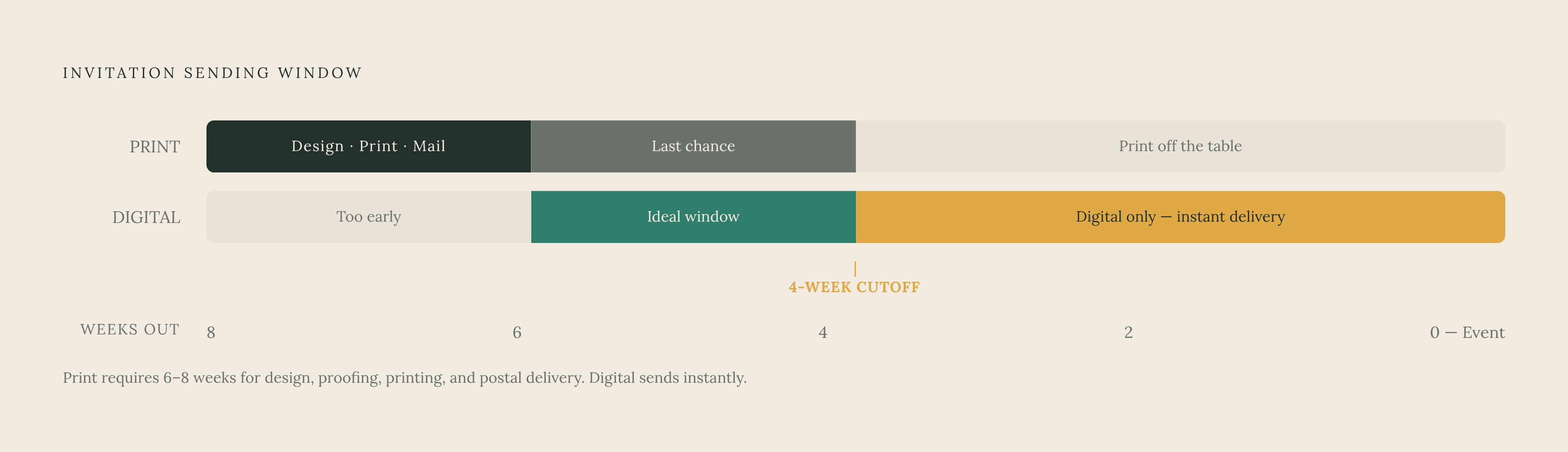
Timing can remove a choice before taste enters it. Printed invitations should be sent 6–8 weeks before the shower, and the schedule needs time for design, proofing, printing and delivery by post. Digital invitations can go out 4–6 weeks before because delivery is instant, although that does not remove the rest of the planning.
Baby shower guidance allows 1–2 weeks before the event, with two weeks providing the follow-up buffer described above. With less than four weeks remaining, print is functionally off the table unless cards can be hand-delivered locally. A host starting at five weeks out is already inside the digital sending window and past the recommended printed one, so the calendar has effectively made the call.
What the invitation must include regardless of format
Once the format is chosen, content becomes the next job. Invyt identifies seven essentials, beginning with the guest of honour and the host’s name and contact details. The invitation also needs the date, start time and end time, plus the venue’s full address or the word “virtual” and the platform name. The end time deserves its space. Without it, guests may wait for someone else to make the first move towards the door.
The remaining essentials are the RSVP deadline with one clear reply method, a registry link, and a clear statement about whether children and partners are included. A registry link is normal on a baby shower invitation and belongs on one short line. For an invited-guests-only event, the wording can be direct. “We've planned for the guests named on this invitation. Thank you for understanding!”
At an Australian café shower where guests pay for their own food, that cost must be stated plainly so they can make an informed decision. Questions should go to the host. The language should also fit the event, with warm, friendly wording for a backyard gathering and a fuller written-out format for a more formal afternoon.
Special formats need their own practical instructions. A surprise invitation should put “Shhh — it's a surprise!” first, give an arrival time before the reveal and send replies to the organiser, never the mother-to-be. A co-ed shower needs explicit wording such as “co-ed,” “couples shower” or “all genders welcome”. Virtual or hybrid showers need a clear call to action, an explicit time zone and details of when the join link will be released.
When a hybrid approach handles what neither format alone does well
A mixed-access guest list does not require one format for everyone. A small printed run for guests who need paper, with digital invitations for the rest, solves the specific problem of reaching both groups without paying to post every invitation. Paper handles access and the physical experience, while digital handles most of the sending and response collection.
The wording should be identical across both versions. No guest should receive less information or feel that their invitation is the lesser edition. A QR code on the printed card can link to the digital RSVP page, giving a guest a physical invitation while providing the host with a structured response. That bridge suits someone who likes paper but can use the form. It does not remove the access problem for someone unable to use a digital link.
To manage the split, hosts should tag each guest as print or digital in the planning list. Hosts then order printed cards only for guests tagged as print, and send everyone else the digital link. Both groups get the same invitation design, so the format meets their needs without giving one group more ceremony than the other.
Applying the four factors to make the call
The decision starts with the constraint that is hardest to move. If fewer than four weeks remain, digital is the practical choice unless local hand-delivery makes paper possible. If budget is the main limit, a flat-fee digital platform saves meaningfully per guest over print for a mid-sized shower.
Guest access can override those savings. A significant group of older or less digitally connected guests points towards printed cards for them and digital invitations for the rest. If the main challenge is accurate headcounts, dietary information and follow-ups, an event page with a built-in RSVP form addresses that workload.
Paper still has a clear place in the decision. When formality and keepsake value are the priorities, and the guest list is comfortable with post, a full printed run is a sound choice. The extra spending buys something the host deliberately wants. There is no universally correct invitation format, only the one that fits the host’s budget, reply workload, guests and available time.